India is vulnerable to a large number of natural disasters. Notably, about 58% of the landmass is prone to earthquakes of moderate to high intensity, 12% of the land is prone to floods and river erosion, and 68% of the cultivable area is susceptible to drought, landslides and avalanches. In addition, the Indian Himalayas is one of the most disaster-prone regions of the world. Neo-tectonic activities in the Hindu Kush Himalaya (HKH) region along the several active thrusts and faults are responsible for earthquake disasters whereas climate change and land use degradation accelerate the flash floods, river-line floods, erosion, wet mass movement during monsoons and droughts in non-monsoon periods. As exemplified by the Uttarakhand disaster in 2013, climate change can lead to extreme events like cloudbursts leading to devastating floods and landslides.
Multiple bio-geographic zones converge in the Himalayas and hence, species of the Indo-Malayan Southeast Asian tropical zone, Palaearctic Realm, temperate East Asia and Deccan Plateau occur in this region. However, this biodiversity is now under increasing pressure due to a number of reasons. Principally, the rapid economic growth of this region has resulted in an expansion of industrial agriculture, extensive infrastructure development and land-use change. At the same time, drivers such as illegal wildlife trade and climate change have further aggravated the loss of biodiversity. A critical environmental issue in the Himalayas is biomass extraction from the forests for energy. To address this issue, trees need to be planted on a regular basis. Ultimately, more effort needs to be made to unite this region into a mode of sustainable preparedness. It is imperative that we empower the local communities and ensure the inclusion of marginalized and vulnerable groups.
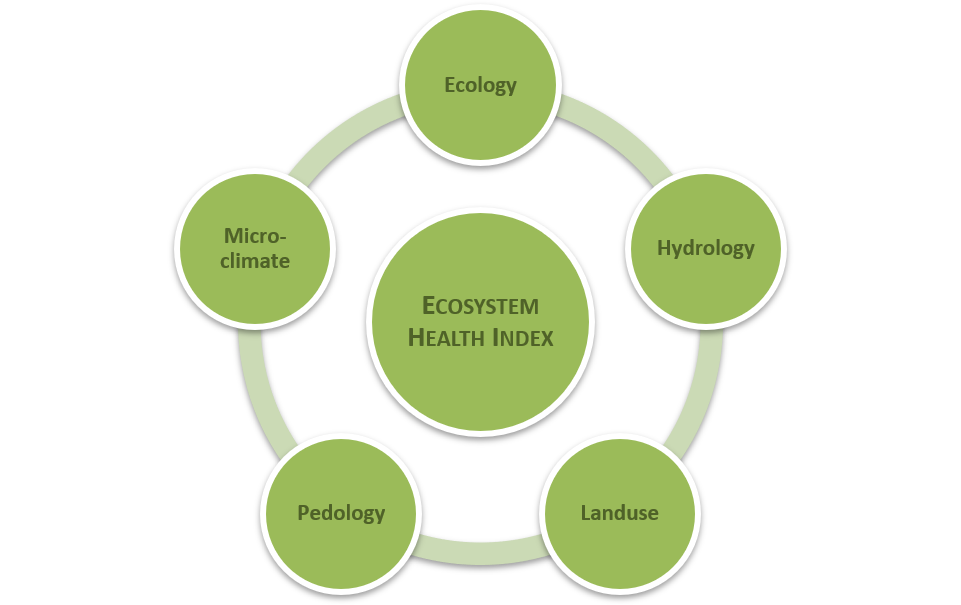
The Eco-Health Index is a composite index and includes an assessment of five factors: Vegetation, hydrology, land use, stability and micro climate. Accordingly, all these variables have been aggregated into the Eco-Health index.
With floods and landslides increasing exponentially in the last three decades. the region displays low resilience, with no reduction in the disaster death toll year upon year. As a result, Disaster Management has become one.this is after read more button text this is after read more button text this is...
Click the link below to read about Pragya’s initiative to train the next generation of the Himalayan community as Himalayan conservationists. This special group serves as ongoing change agents vis a vis conservation and disaster management in Himalayan society.